
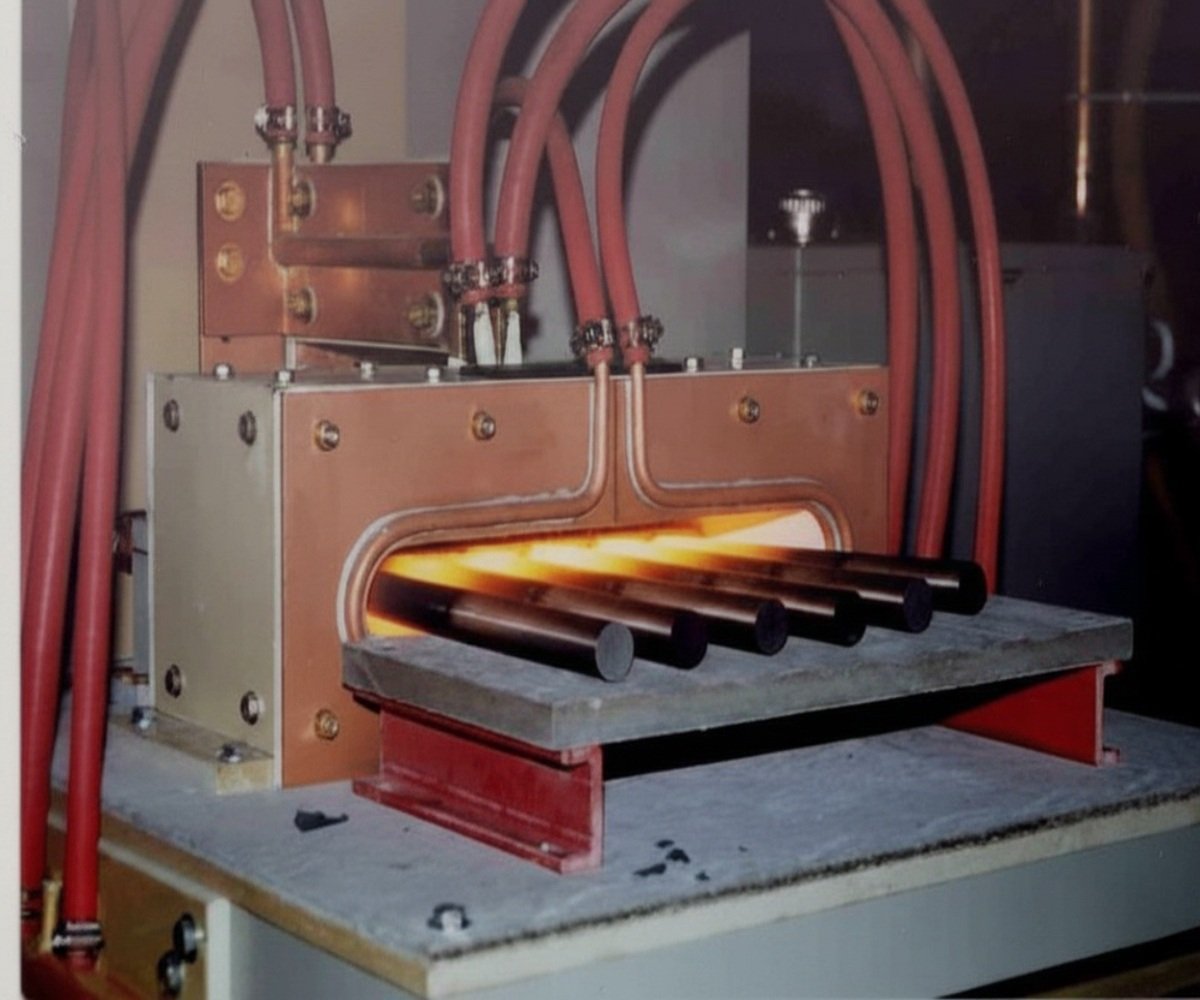
At Dayalu Induction, we engineer specialized systems for targeted heating of metal bar ends—delivering precision, speed, and repeatability for forging, upsetting, bending, and joining operations. Our technology uses high-frequency electromagnetic fields to heat only the required portion of the bar, preserving the integrity of the rest.
Induction end bar heating is a localized heating process in which only the extremities of a metal bar are heated using electromagnetic induction. The bar is positioned so that its end sits within a custom-designed induction coil, where eddy currents generate heat through electrical resistance.
This method provides precise thermal control without affecting the full length of the bar—making it ideal for high-speed, automated industrial workflows.
To selectively heat the ends of metal bars for forming, forging, upsetting, or joining without heating the entire workpiece.
Before Heating: Solid
After Heating: Solid
The process elevates temperature locally while preserving the bar’s overall structural and metallurgical integrity.
Achieve localized, repeatable heating at the bar end with minimal thermal impact on surrounding material.
Induction end bar heating is not intended for full-length heating or melting—it is designed for targeted thermal precision in high-speed forming and shaping operations.
Common applications include:
Upset forging and hot heading
End forming and bending
Thread rolling and tapering
Joining and welding preparation
Result: Precisely heated bar ends with consistent temperature profiles, ready for mechanical deformation or joining—without scale formation or distortion.
Only the bar end is heated, preserving material properties throughout the remainder of the workpiece.
High-frequency induction enables fast, repeatable heating—ideal for automated and inline production.
Non-contact heating significantly reduces surface degradation compared to flame-based methods.
Focused heating minimizes energy consumption and lowers overall operating costs.
Microcontroller-based systems ensure consistent temperature control, real-time feedback, and seamless integration with forming or quenching stations.