
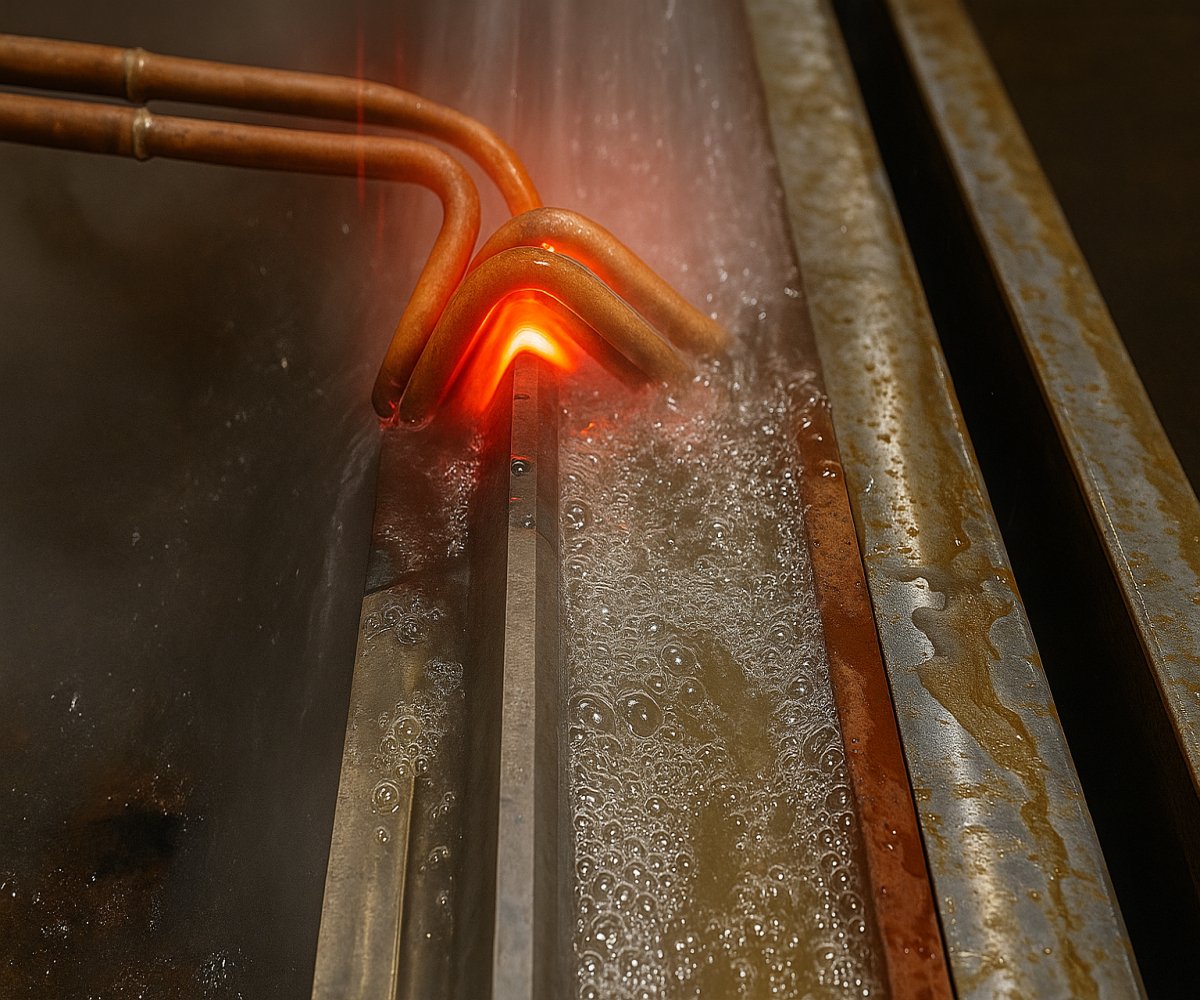
At Dayalu Induction, we deliver precision-controlled induction hardening systems designed to enhance surface durability without compromising core toughness. Our technology uses high-frequency electromagnetic fields to selectively heat and quench metal surfaces—creating hardened layers that resist wear, fatigue, and impact.
Induction hardening is a localized heat treatment process used to increase the surface hardness of metal components. The part is rapidly heated using electromagnetic induction, then immediately quenched in water, oil, or polymer. This thermal cycle transforms the surface into martensite, a hard and wear-resistant microstructure, while maintaining a ductile core.
It’s ideal for components exposed to friction, cyclic stress, or impact—delivering durability without compromising flexibility.
System Advantages
– Selective Surface Hardening
Only the required areas are treated—minimizing energy use and avoiding distortion.
– Rapid Heating & Quenching
High-frequency induction delivers instant heat, followed by controlled quenching for martensitic transformation.
– Depth Control & Repeatability
Adjustable frequency and power settings allow precise control over case depth and hardness profile.
– No Furnace Required
Compact systems eliminate the need for bulk heating or long thermal cycles.
– Microcontroller-Based Logic
Digital control ensures consistent results, process monitoring, and integration with automated lines.